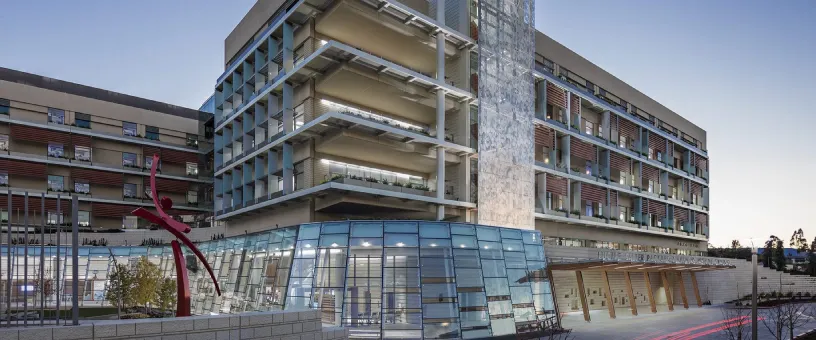
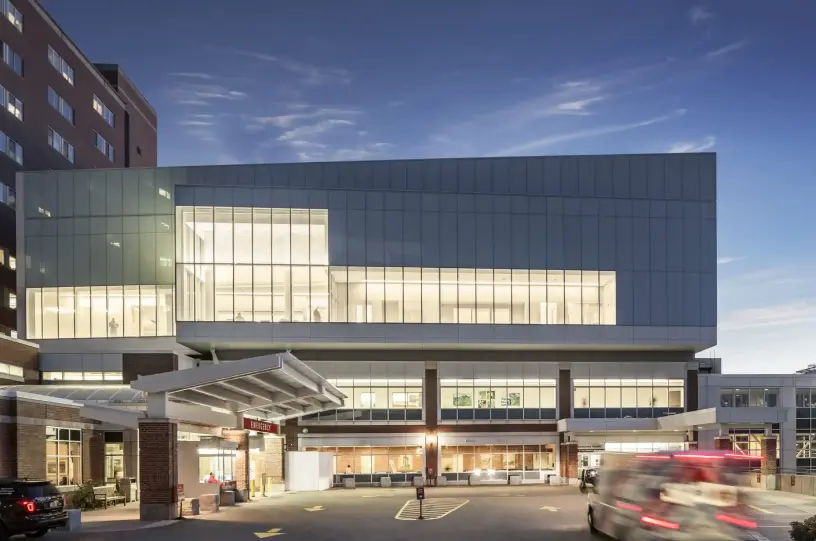
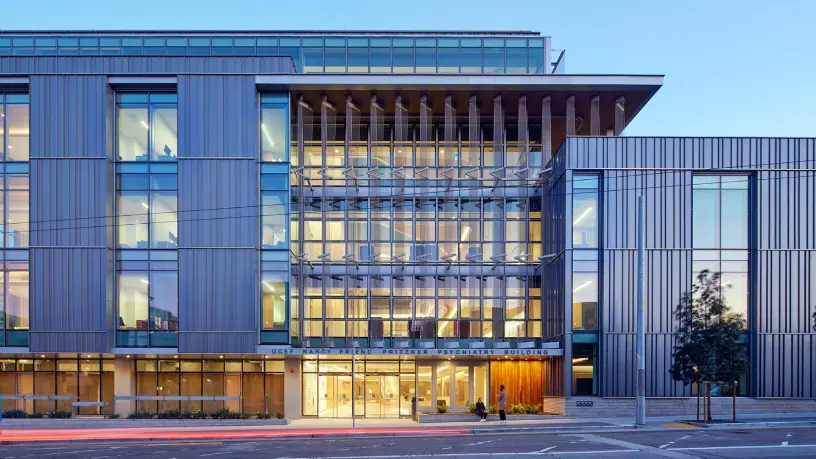
The UCSF Health Helen Diller Hospital is a next-generation, large-scale academic medical facility designed to support advanced clinical care, research integration, and long-term campus expansion. The project introduces a highly articulated building form organized into distinct programmatic layers, integrating patient care spaces with landscaped terraces and public amenities to create a “healing habitat” connected to its surrounding environment.
The enclosure design responds to both performance-driven healthcare requirements and the architectural vision, combining terracotta cladding, high-performance glazing systems, and complex transitions across multiple facade typologies.
RDH is serving as Building Enclosure Consultant and Facade Engineer, providing integrated services from early design through ongoing technical development. The team is supporting enclosure system selection, performance detailing, and coordination across disciplines to align the architectural intent with constructable, high-performance solutions.
By also delivering facade structural engineering, RDH brings a unified approach to resolving system behavior, attachment strategies, and movement across a large, seismically active site, supporting continuity between design and fabrication.
Healthcare environments demand elevated enclosure performance to support strict indoor environmental control, continuous operation, and long service life. RDH’s approach focuses on developing durable, resilient facade systems that address air, water, and thermal control while accommodating complex geometry and program-driven massing.
The building’s layered form introduces a range of interface conditions between terracotta cladding, curtain wall systems, and transitional assemblies. RDH is advancing detailing strategies that address differential movement, seismic demands, and constructability across these systems, particularly at critical junctions between primary facade zones and terrace conditions.
Close coordination with the facade contractor supports alignment between design intent and fabrication constraints, with an emphasis on prefabricated system integration, quality control, and performance validation as the project progresses.
Once complete, the hospital will expand UCSF’s capacity to deliver complex care within a highly specialized clinical environment, while redefining how healthcare facilities integrate with their surroundings.
RDH’s involvement supports a facade strategy that balances architectural expression with technical rigor—advancing enclosure performance, constructability, and long-term durability for one of the most significant healthcare projects currently in development.